Note
Access to this page requires authorization. You can try signing in or changing directories.
Access to this page requires authorization. You can try changing directories.
Overview
Traditional Arabic is a typeface designed for typesetting the Arabic language and other languages that use the Arabic script. It is in the traditional Naskh style, which is commonly used to typeset text in Arabic. It is an appropriate typeface for body text and long documents.
The typeface, originally designed for the Arabic language, was later expanded to cover Persian as well. The font supports OpenType layout features for accurate Arabic typesetting, as well as traditional ligatures, flourished (swash) forms, and “phrase ligatures” tradtionally used in typesetting Arabic books of classic and religious literature.
The design of Traditional Arabic is based on the design of classic metal Arabic typefaces, most notably the Amiri typeface developed by the Amiriyya Press (also known as Bulaq Press) in Cairo in the early 20th century. There are two weights, Regular and Bold. The font includes capitals and lowercase letters for the Latin alphabet, derived from Monotype Bembo.
| Item | Description |
|---|---|
| File name | trado.ttf tradbdo.ttf |
| Styles & Weights | Traditional Arabic Traditional Arabic Bold |
| Designers | N/A |
| Copyright | © 2026 The Monotype Corporation. Portions © Monotype Imaging. All Rights Reserved. |
| Font vendor | Glyph Systems |
| Script Tags | dlng:'Arab' slng:'Arab', 'Latn' |
| Code pages | 1252 Latin 1 1256 Arabic |
| Fixed pitch | False |
| Download | N/A – Exclusively included with Microsoft products and services where applicable. |
Enhancements:
The original font, designed for Arabic language, was later expanded to cover Persian as well. In addition, a number of ligatures were added to enhance the calligraphic quality of the font. Over the years we did a number of enhancements to ensure visual consistency at the glyph as well as composed word levels. The metrics and appearance of the font were preserved despite all these improvements in order to keep the layout and visual character of older documents.
- The image below illustrates that, without altering font metrics, the updated Traditional Arabic fonts deliver smoother cursive connections (red arrows) along with more pronounced and better-balanced teeth (blue arrows).

- The image below shows that glyph shapes have been made more conventional and consistent—both across different glyphs within each weight and between the two weights.
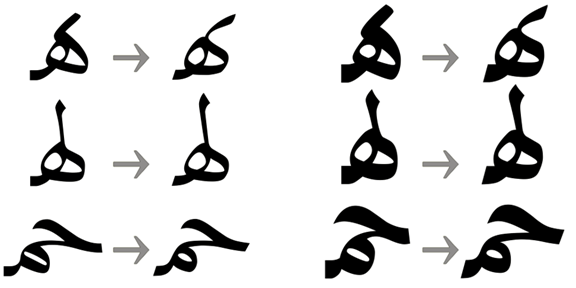
- The image below shows that, to ensure consistency in composed text, missing ligatures have been added to the Traditional Arabic fonts. To prevent unexpected reflow in existing documents, these new ligatures are available as an opt-in via Stylistic Sets in Microsoft Word.

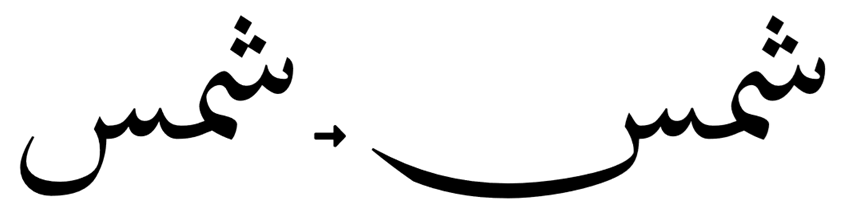
- The image below shows that an extensive set of traditional honorifics phrase ligatures added to the Traditional Arabic fonts, reflecting their frequent use in the typesetting of classical and religious Arabic texts.

- Stylistic Set 1: Short Meem Substitutes alternate form short-tailed Meem for all Meem isolated and final forms. Use this stylistic set to add a different calligraphic flavor or to avoid the tail that drops below the base line.

- Stylistic Set 2: Complete ligatures Complete set of ligatures to complement the existing, partially complete, ligature set. Also lowers dots on tooth+Yeh ligatures following Reh forms. Use this stylistic set for ligature consistency across similar letter combinations. Note that ligatures always require less width, so this can also be useful when space is limited.
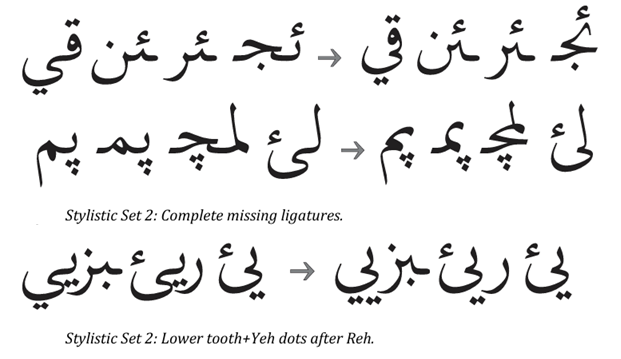
- Stylistic Set 3: Stylistic Set 2 ligatures along with new ligatures; updated kerning; and calligraphic enhancements Includes Stylistic Set 2 as above, and additional ligatures for calligraphic enhancement. Substitutes narrower tooth+Alef ligatures for improved spacing. Substitutes wider tooth+Reh ligature instead of inserting a Kashida when marks are present for improved legibility (Fig. 12). Use this stylistic set for more authentic Naskh style calligraphy.

- Stylistic Set 4: Wide marks Use this stylistic set to substitutesfor larger vowel marks that are more legible and exude a more calligraphic feel to composed text. wider letters.

- Stylistic Set 5: Persian style Heh Substitutes normal Heh medial with alternate Persian style Heh medial form. Use this stylistic set if you desire a more Persian feel or a different visual undulation.

- Stylistic Set 6: Swash Applies swash extension to isolated and final letters that accept extension (Beh, Seen, Sad, Feh, Qaf, Kaf, Lam, Noon and Yeh). Use this stylistic set to expand the width of text for justification or for typographic impact.
- Riyal update, designing and integrating the Riyal symbol into this font posed unique challenges, as the existing currency symbols do not follow a single, unified visual design system. The solution reflects a careful balance, ensuring the new symbol harmonizes with existing currency symbols and ASCI numerals.
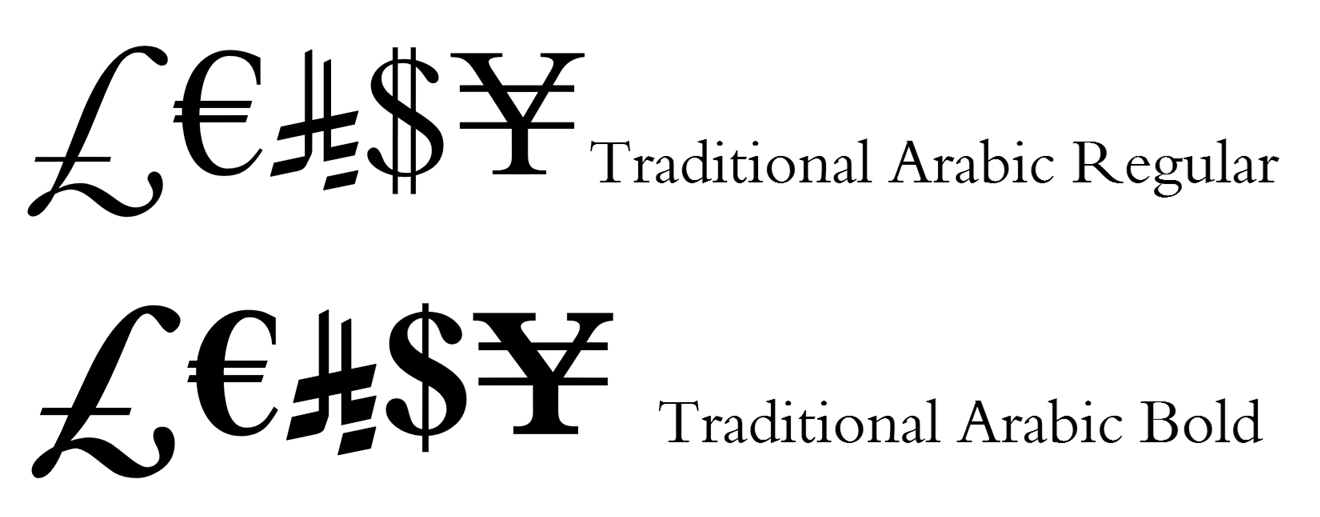
- Two alternate Riyal symbol designs are provided as stylistic set options, allowing users to choose a form that best aligns with their typographic or regional preferences. SS07: A user-selectable option that aligns with the cursive nature of the font.
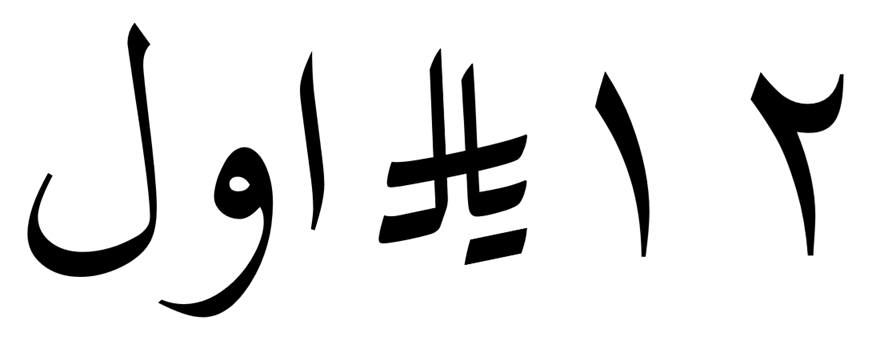
- SS08: A design that aligns more closely with the officially announced geometric form.

Licensing and redistribution info
- Font redistribution FAQ for Windows
- License Microsoft fonts for enterprises, web developers, for hardware & software redistribution or server installations
Products that supply this font
| Product name | Font version |
|---|---|
| Windows 11 | See the Windows 11 page. |
| Windows 10 | See the Windows 10 page. |
| Windows 8.1 | See the Windows 8.1 page. |
| Windows 8 | See the Windows 8 page. |
| Windows 7 | See the Windows 7 page. |
| Windows Vista | 5.00 |
| Windows XP | 1.01 |
| Windows Server 2008 | 5.00 |
| Windows Server 2003 | 1.01 |
This typeface is also available within Office applications. For more information visit this page.
Style & weight examples
Traditional Arabic

Traditional Arabic Bold
